
A Great Word
 by Ryan Krzykowski (featuring Jeff Sopha’s work)
A couple months back, I read a post written by Coach Jeff Sopha (and 2026 Sharon Thompson Metro KC Coach of the Year recipient) called “Winning Matters, But Not the Way Most People Think”. Jeff has written a series of posts that he shares on Facebook, and they’re all terrific. Something about the “Winning” article from July spoke to me again very recently, and I wanted to include it in this space. Coach Sopha, thank you for sharing these great words, and ultimately for making our city a better place.
Here’s the intro that Jeff wrote leading into the post:
Recently, a parent of a youth player told me they were leaving their current team at the end of summer because they were not winning a lot of games. I asked that parent if they thought their son improved and if he liked his teammates. Was he motivated to keep working hard to get better? Does he still like baseball? The answer to all of those was “yes”. So I then asked why they wanted to leave. I got the sense the parents were confusing winning with development.
Here are my thoughts on the importance of winning in youth sports:
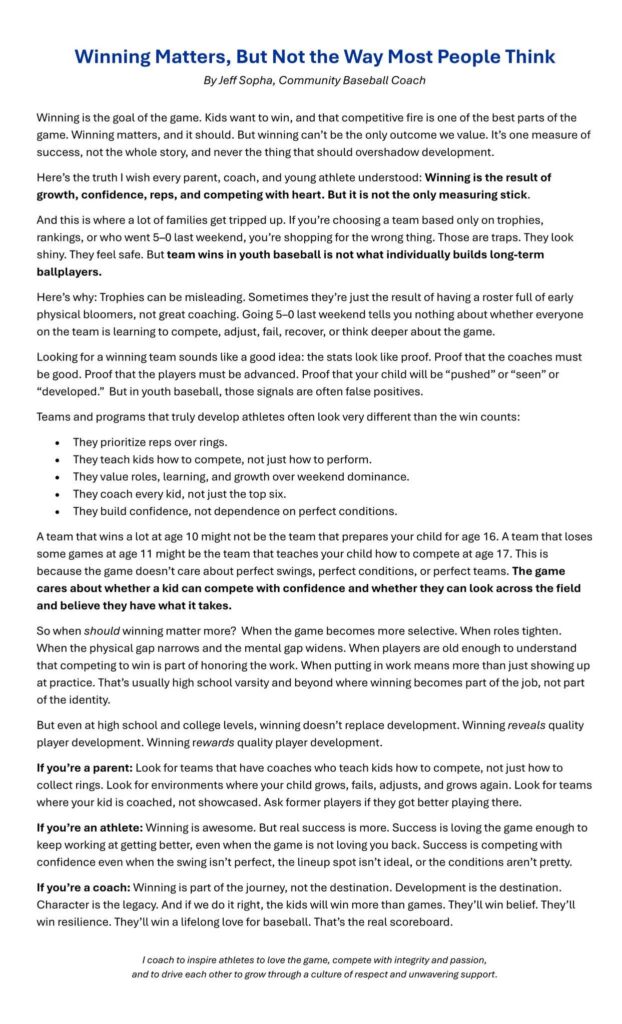
Winning Matters, But Not the Way Most People Think
by Jeff Sopha
Winning is the goal of the game. Kids want to win, and that competitive fire is one of the best parts of
the game. Winning matters, and it should. But winning can’t be the only outcome we value. It’s one
measure of success, not the whole story, and never the thing that should overshadow development.
Here’s the truth I wish every parent, coach, and young athlete understood: Winning is the result of
growth, confidence, reps, and competing with heart. But it is not the only measuring stick.
And this is where a lot of families get tripped up. If you’re choosing a team based only on trophies,
rankings, or who went 5–0 last weekend, you’re shopping for the wrong thing. Those are traps. They
look shiny. They feel safe. But team wins in youth baseball is not what individually builds long-
term ballplayers.
Here’s why: Trophies can be misleading. Sometimes they’re just the result of having a roster full of
early physical bloomers, not great coaching. Going 5–0 last weekend tells you nothing about whether
everyone on the team is learning to compete, adjust, fail, recover, or think deeper about the game.
Looking for a winning team sounds like a good idea: the stats look like proof. Proof that the coaches
must be good. Proof that the players must be advanced. Proof that your child will be “pushed” or “seen”
or “developed.” But in youth baseball, those signals are often false positives.
Teams and programs that truly develop athletes often look very different than the win counts:
They prioritize reps over rings.
They teach kids how to compete, not just how to perform.
They value roles, learning, and growth over weekend dominance.
They coach every kid, not just the top six.
They build confidence, not dependence on perfect conditions.
A team that wins a lot at age 10 might not be the team that prepares your child for age 16. A team that
loses some games at age 11 might be the team that teaches your child how to compete at age 17. This
is because the game doesn’t care about perfect swings, perfect conditions, or perfect teams. The
game cares about whether a kid can compete with confidence and whether they can look
across the field and believe they have what it takes.
So when should winning matter more? When the game becomes more selective. When roles tighten.
When the physical gap narrows and the mental gap widens. When players are old enough to
understand that competing to win is part of honoring the work. When putting in work means more than
just showing up at practice. That’s usually high school varsity and beyond where winning becomes part
of the job, not part of the identity.
But even at high school and college levels, winning doesn’t replace development. Winning reveals
quality player development. Winning rewards quality player development.
If you’re a parent: Look for teams that have coaches who teach kids how to compete, not just how to
collect rings. Look for environments where your child grows, fails, adjusts, and grows again. Look for
teams where your kid is coached, not showcased. Ask former players if they got better playing there.
If you’re an athlete: Winning is awesome. But real success is more. Success is loving the game
enough to keep working at getting better, even when the game is not loving you back. Success is
competing with confidence even when the swing isn’t perfect, the lineup spot isn’t ideal, or the
conditions aren’t pretty.
If you’re a coach: Winning is part of the journey, not the destination. Development is the destination.
Character is the legacy. And if we do it right, the kids will win more than games. They’ll win belief.
They’ll win resilience. They’ll win a lifelong love for baseball. That’s the real scoreboard.
Thanks, Coach Sopha. Let’s Coach With Purpose…